
Help students take the next step when they get stuck
Use a student's course record and private messages to find what is holding them up and agree on a useful next step.
A student who stays on the same task may need help with the work, more time or a review from you. Check where they are before sending a reminder to finish.
In this guide, we use Lucía from the sample photography course at Hawkings Academy. She has reached the five-photo story assignment. Her course record gives the teacher a place to start a useful conversation.
Check the task before writing
Open the student's Course record for the group you are teaching. Look at their current step and completed work, then expand the task to read the brief and check any response.
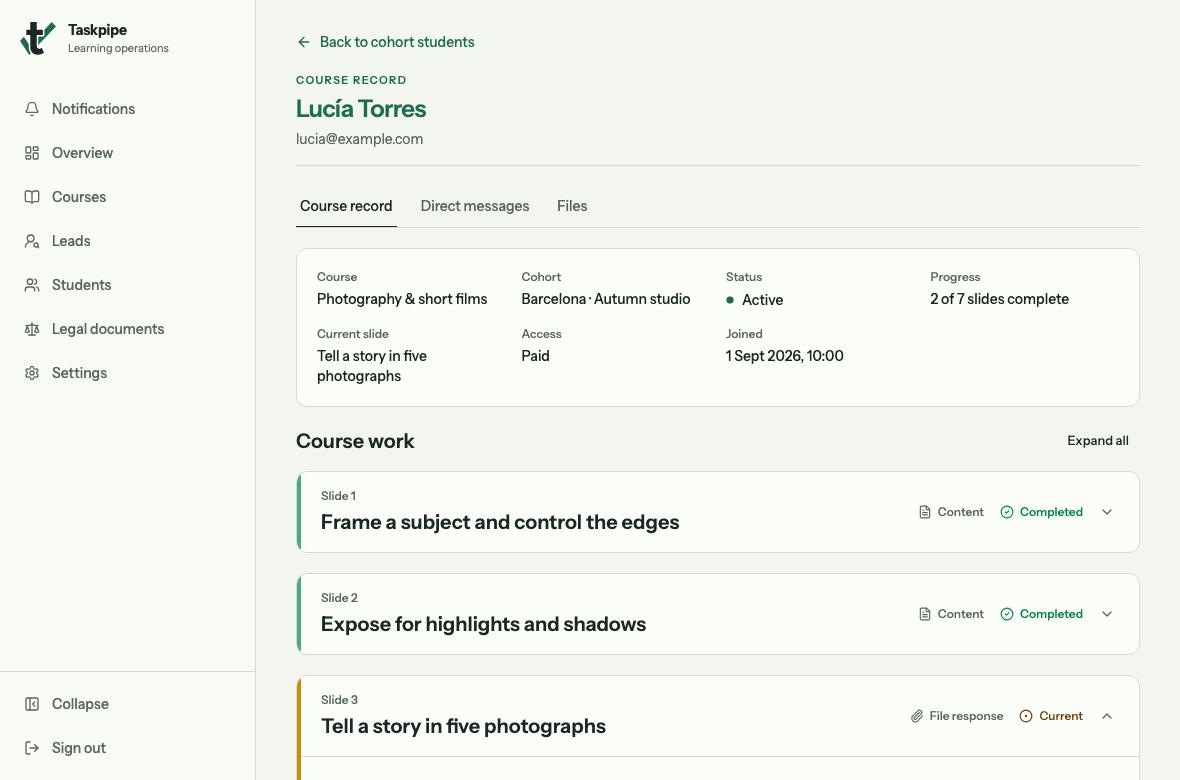
Lucía has completed two of seven steps. Her current task is the photo story; Direct messages gives you a place to discuss it privately.
Check whether the work is still a draft or has been submitted. A student may have saved work without handing it in. If the task requires approval and they have submitted it, they may be waiting for your review.
Also check the task's opening time, deadline and rule for continuing. A student can be waiting because of the way the course is set up. The practice and feedback guide explains these rules.
Ask about one concrete difficulty
Use Direct messages to ask about the task in front of them. Keep the question short enough to answer without writing a long explanation.
For the photo story, you could write:
Hi Lucía, how is the five-photo story going? Is choosing the images or putting them in order the harder part? Tell me where you are stuck and we can work through it.
Let the student explain. They may have a question about the brief, a problem sending a file or too little time this week. Each answer calls for different help.
Agree on a small next step
If choosing five photographs feels too large, ask the student to choose the opening image first and explain what it tells the viewer. They can use that choice to guide the rest of the sequence.
Make clear that this is a way into the assignment. The final submission still needs to meet the brief. If the student is unsure what good work looks like, point to one requirement and explain how to judge it.
If their work is already submitted, review it before asking for more. Say what works, name the main point to improve and explain what happens next. When the task needs approval, a message alone does not clear that step; review and approve the submitted work when it is ready.
Set a time to check back
Agree when you will return to the work. For example, ask the student to choose their opening image by Thursday and plan to discuss it on Friday. Keep that promise within the support your course includes.
If several students ask the same question, add a clearer explanation or an example to the lesson. Share advice that helps the group without sharing anyone's private message or unfinished work.
Use what you learn to improve the next course run too. The course groups guide explains how each group keeps its own copy of the lessons, so check which copy you are editing.